A pear farm sales website and a private delivery management system
01Public website
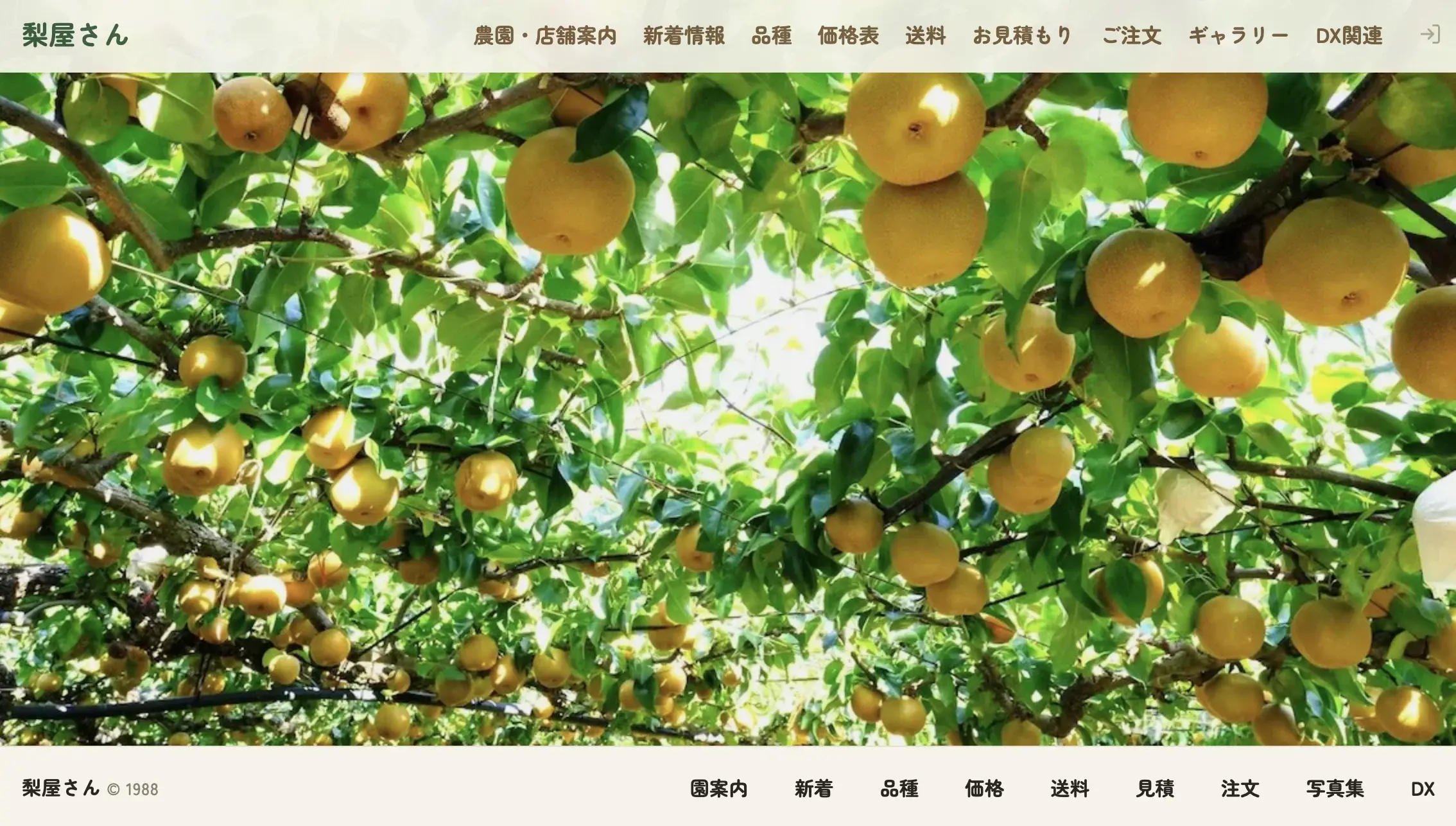
The customer-facing website introduces the farm, pear varieties, pricing, shipping, quotations, and ordering information.
Overview
Project overview
This first part covers the public Nashiyasan website: the website customers can visit online. It brings together the story, sales information, and ordering guidance of a pear farm in Kurume, Fukuoka. It is separate from the private farm delivery management system introduced later on this page, with a different audience and purpose.
Each variety page combines photography with harvest timing, key characteristics, average sweetness, and the distinction between green and red pears. A visual chart shows when each variety is in season. Product and shipping tables respond to variety, box size, intended use, destination, and refrigerated-delivery requirements, while the quotation tool calculates product cost, shipping, refrigeration fees, and the total based on the visitor’s selections.
The order page clearly explains how to order by phone, fax, or email, with a copyable email template and a downloadable Excel order form. Availability states such as open, temporarily paused, not yet open, and closed are managed per variety and reflected consistently across pricing, quotation, and ordering pages.
The farm can update public-site content from a dedicated editing screen. Varieties, pricing, shipping fees, opening days, news, photography, and reservation status can be changed without editing code. This content editor is used to operate the public website; it is separate from the order, shipping, invoice, and payment records held in the private delivery management system.
The site also includes an opening calendar, maps and contact details, payment information, news distribution, Facebook integration, a photo gallery, and on-site search. It is designed for comfortable mobile viewing, fast image display, clear search results, and traffic monitoring.
A site people can find through search and use to reach the right sales information
Visible for local search intent
At the time checked in Google Search Console, average positions were around 1 for searches such as “久留米 梨”.
A clearer entry point from search
The site organizes farm, location, and pear-related information so people can reach the official website from relevant searches.
Sales information can be updated by the farm
Varieties, prices, shipping fees, and availability can be changed by the farm as the season changes.
A clearer path from pricing to ordering
Visitors can move from prices and shipping to quotations and ordering guidance in one connected flow.
Search and traffic observations are based on Google Analytics and Google Search Console reports. Search positions can vary by timing and search conditions, and these figures do not represent a direct effect on sales or order volume.
02Private delivery management system
A pear-farm delivery management system connecting orders, shipping, invoices, and payments
The strongest part of this project is not the number of features. It is the way complex pear-farm delivery work has been translated into a system that helps staff manage orders, labels, shipping, invoices, and payments with fewer mistakes during the busiest weeks of the season.
A private dashboard used only by farm staff. The personal name shown in the original screen has been blurred for privacy.
The Nashiyasan delivery management system was developed to support direct sales and shipping at a working pear farm. Rather than adapting a generic customer-management product, I mapped the actual work and brought customer records, orders, delivery addresses, products and pricing, shipping fees, labels, invoices, payments, and reporting into one connected flow.
Pear sales involve exceptions that ordinary online-store software often handles poorly: one customer ordering several varieties for multiple addresses, names that differ between sender and recipient, annual changes in prices and refrigerated-shipping rules, mixed-variety consignments, and shipped and collected orders within the same season. The data and editing screens are designed around these realities without forcing the farm to change its established workflow.
Operational results
Automated printing for approximately 700 shipping labels
Automated production of approximately 100 invoices
Customer, order, shipping, invoice, and payment records managed in one system
Shipping-label and invoice counts are approximate cumulative figures based on operation records in the delivery management system.
One flow from order to payment
Multiple varieties, destinations, box quantities, and shipping progress can be handled separately while remaining part of one order. Prices and shipping are calculated from the relevant conditions, while dispatch, invoicing, and payment progress are derived automatically. Provisional orders based on the previous season remain isolated from normal billing and reporting until confirmed.
Document output designed around real paper forms
The system produces Yamato and Sagawa shipping labels, invoices, envelope labels, customer lists, and reports. Label PDFs are aligned to the physical forms, including dimensions, text placement, and print scaling. Consolidation rules and box limits are checked, and print count and last-print time are recorded to reduce duplicate printing during peak season.
Designed to reduce operational mistakes
Cancelled orders and invoices retain their history while being excluded consistently from shipping, billing, reporting, and exports. Issued invoices preserve the original content. Warnings cover unsaved changes, duplicate submissions and orders, label reprints, and missing annual settings before they can affect live work.
Input support for day-to-day use
Name-to-kana assistance, postcode-based address entry, delivery-region detection, and similar-customer checks reduce repetitive work. The system also handles the complex personal, company, job-title, and family-name formats required on Japanese labels and invoices. Theme and display-size controls help different users work comfortably.
View architecture and test detailsFor developers and technical readers
This section describes the production architecture, security controls, and testing approach for readers interested in the implementation details of a system that handles personal data.
Django 5.2 and PostgreSQL support a connected delivery-management data model covering customers, orders, delivery, invoicing, and payments.
Security controls include enforced multi-factor authentication, login-attempt limits, HTTPS, security headers, audit logs, and GPG-encrypted database backups.
An AST-based test scans all runtime code for unsafe patterns related to PostgreSQL row locking. Cross-cutting smoke tests cover admin creation pages to catch production-only server errors before release.
AI is limited to supporting tasks that do not require personal data. Rule-based behavior remains available when an external API is unavailable, and core order, billing, and shipping work does not depend on external AI.
Approx. 34,000Lines of Python
348Test methods
128Migrations
Figures as of July 2026. They will change as development continues.